
Concrete Types
- Home
- /
- Concrete Types


- Concrete Types
What is Concrete?
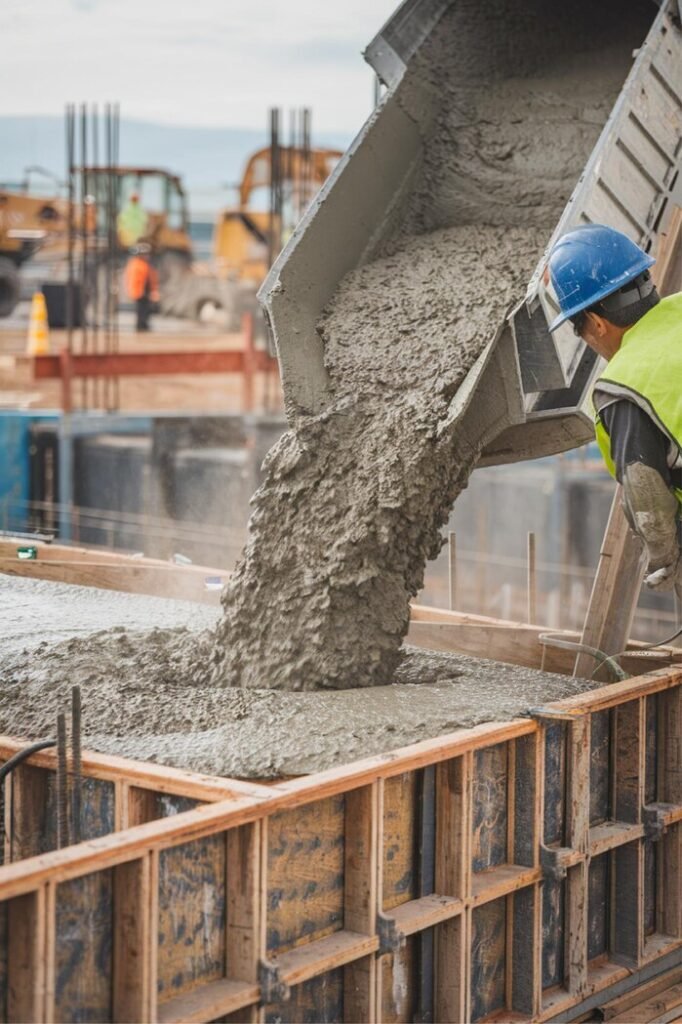
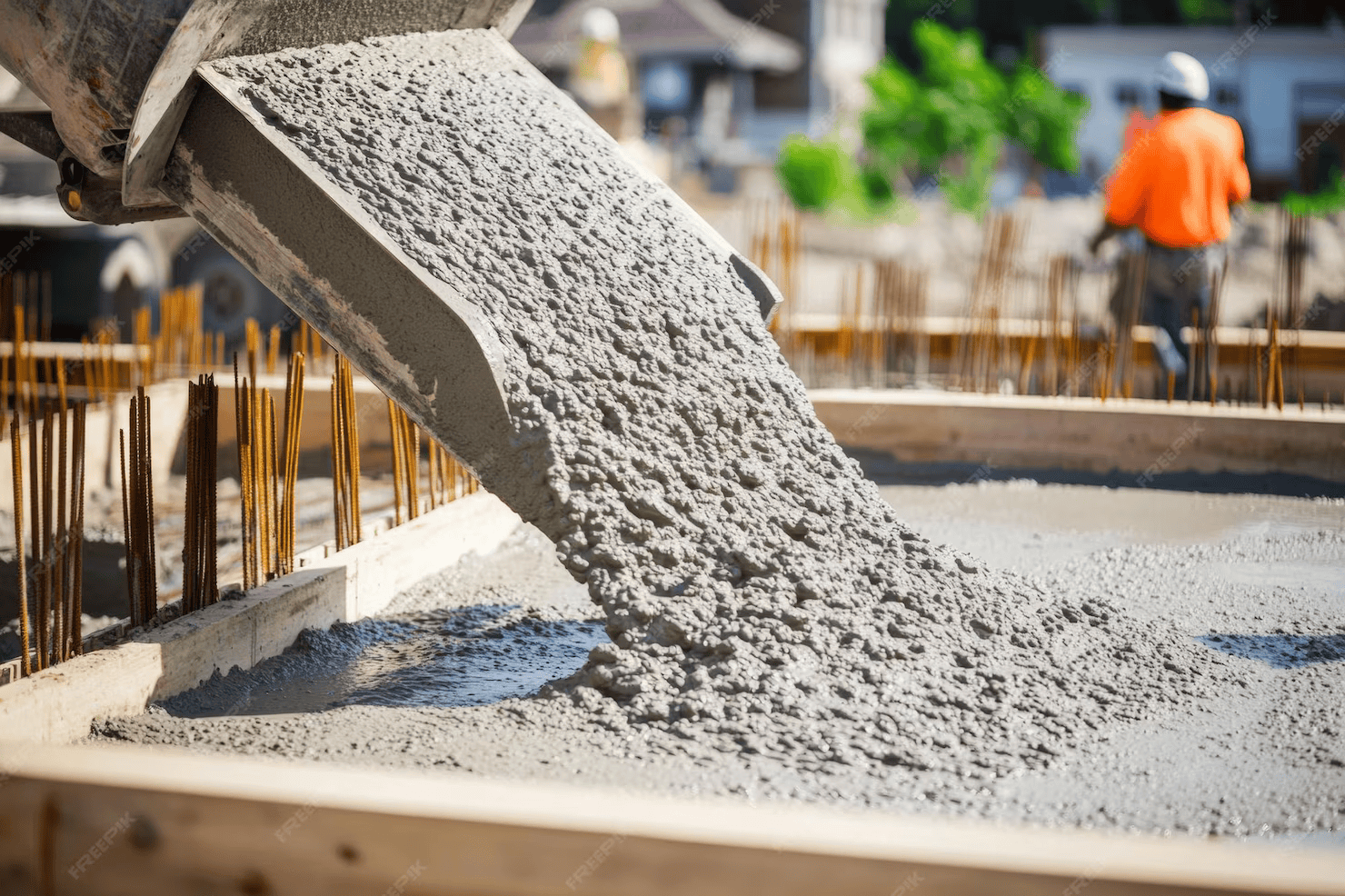
Concrete is the most widely used construction material globally, made by combining cement, fine aggregates (such as sand), coarse aggregates (like gravel or crushed stone), and water. Once mixed, the cement reacts with water in a chemical process called hydration, binding the materials into a solid mass.
Although concrete is inherently strong in compression, it has limited tensile strength, which is why it is often reinforced with steel bars (RCC). It can be poured into any mould or formwork, allowing designers and engineers to create almost any structural shape.
Applications:
Used in all sectors of construction—residential buildings, commercial complexes, infrastructure projects like bridges, roads, flyovers, dams, tunnels, and more.
Composition of Concrete
Concrete derives its strength and durability from the precise combination of its components:

- Cement (Binding Material)
- Acts as the primary binder.
- Reacts with water to initiate the hydration process.
- Holds aggregates together to form a hard, durable matrix.

- Aggregates
- Fine Aggregates (Sand): Fill voids and ensure smooth finish.
- Coarse Aggregates (Gravel/Crushed Stone): Provide bulk, strength, and dimensional stability.
- Do not react chemically but add to concrete’s mass and reduce shrinkage.

- Water
- Essential for chemical reaction with cement.
- Directly affects workability, strength, and durability.
- Must be clean and free of impurities.

- Admixtures (Optional)
- Added in small quantities to modify specific properties.
- Types:
- Accelerators – Speed up setting.
- Retarders – Delay setting for longer workability.
- Water reducers – Improve flow without adding water.
- Air entrainers – Introduce tiny air bubbles for freeze-thaw resistance.
Types of Concrete
A basic mix of cement, sand, aggregates, and water—without steel reinforcement. It is strong in compression but weak in tension and is mostly used for non-structural work.
- Common Ratios: 1:2:4 and 1:3:6 (Cement : Sand : Aggregates)
- Applications:
- Foundation base (below RCC footings)
- Non-load-bearing slabs
- Sidewalks, pathways, parking pads
- Flooring for verandas and plinths
RCC incorporates steel reinforcements (rebars) within concrete to handle tensile stresses. It combines the compressive strength of concrete and the tensile strength of steel.
- Thermal Compatibility: Steel and concrete expand at similar rates, reducing cracks.
- Applications:
- Beams, slabs, columns, footings
- Water tanks, bridges, dams
- Pavements, chimneys, retaining walls
- Underground and underwater structures
FRC is concrete containing dispersed fibres (steel, glass, polypropylene, carbon, etc.) that increase toughness, crack resistance, and durability.
- Fibre Aspect Ratio: 30–150 (Length to Diameter)
- Uses: 0.1%–3% of total volume
- Applications:
- Industrial floors, machine foundations
- Airport pavements, bridge decks
- Dams, spillways, and thin shell structures
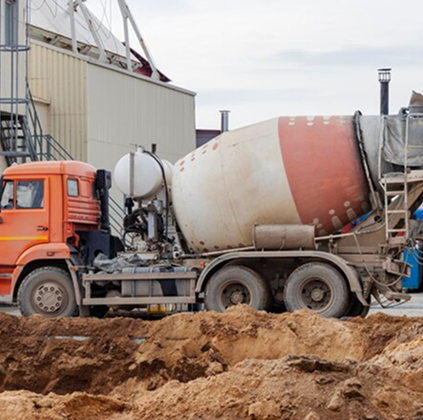
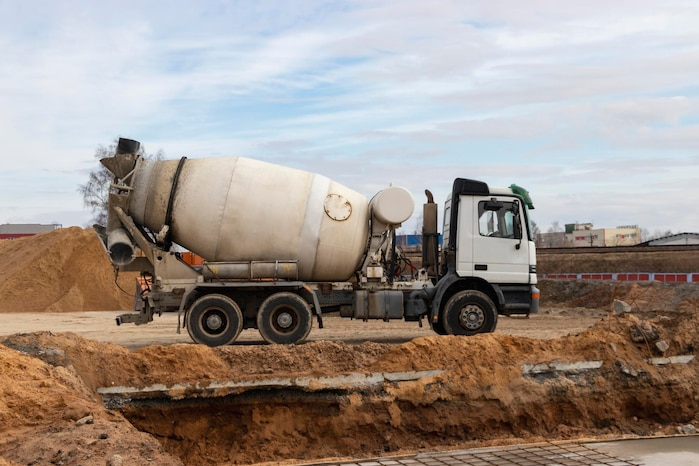
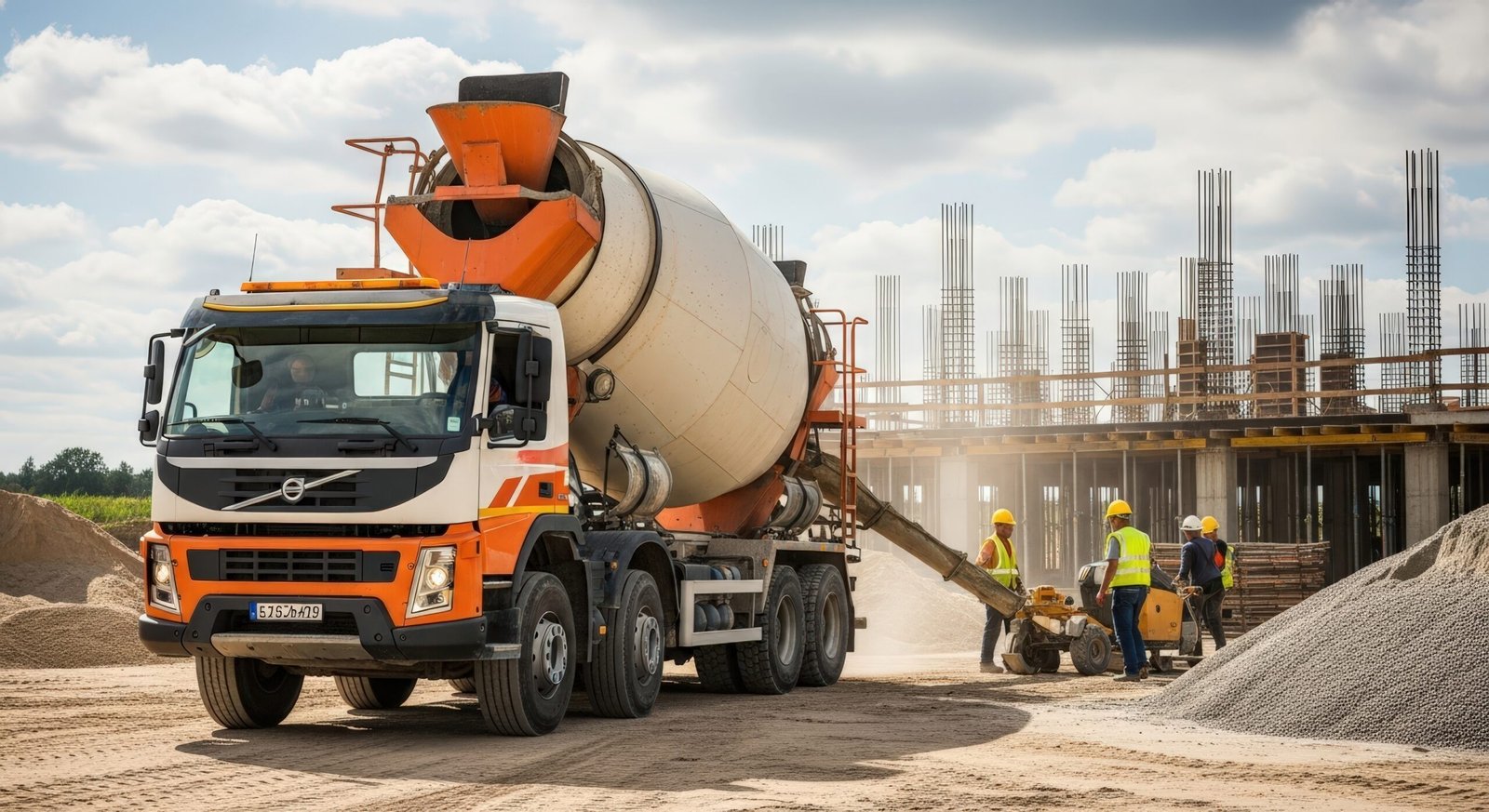
RMC is factory-mixed concrete, delivered to the site in transit mixers. It ensures quality control, consistency, and is ideal for projects requiring speed and precision.
- Mixed in controlled conditions
- Retarders added to delay setting during transport
- Applications:
- Roof slabs and beams
- Large-scale pavements
- Dams, highways, tunnels
- Industrial and commercial buildings
Precast elements are cast and cured in a controlled environment, then transported and assembled on-site. This allows for faster installation and higher precision.
- Advantages:
- Controlled curing and finish
- Faster project timelines
- Applications:
- Beams, slabs, columns, wall panels
- Culverts, drainage channels
- Modular housing, bridges
A method where steel tendons are tensioned to introduce compressive stress before the concrete is subjected to loads.
- Pre-tensioning: Tendons are tensioned before casting.
- Post-tensioning: Tendons are inserted after curing and tensioned in place.
- Benefits:
- Reduced deflection
- Higher load-bearing
- Longer spans with thinner sections
- Applications:
- Flyovers, bridges, girders
- Multi-storey buildings
- Parking decks, retaining walls
Designed to reduce self-weight using:
- Lightweight Aggregates: Pumice, expanded clay, thermocol
- Aeration: Injecting foam or gas (AAC blocks)
- No-fines Concrete: Only coarse aggregates used
- Benefits: Easy handling, thermal insulation, reduced load on structure
- Applications:
- Roof insulation layers
- Long-span decks
- Precast blocks and panels
- Partition walls
Made using heavy aggregates like barite, magnetite, and iron ores to increase weight and radiation resistance.
- Density: 3360–3840 kg/m³
- Applications:
- Nuclear power plant shielding
- Medical X-ray and MRI rooms
- Research labs and bunkers
Engineered for superior strength, durability, and low permeability. Contains mineral admixtures (fly ash, silica fume) and superplasticizers.
- Water-Cement Ratio: ≤ 0.30
- Features: High compressive strength, reduced cracking
- Applications:
- Marine and coastal structures
- Power plants, bridges
- Chemical plants, research centres
Highly flowable concrete that spreads and fills formwork without vibration. Ideal for congested reinforcement.
- Contains: Superplasticizers, viscosity-modifying agents
- Applications:
- Beam-column joints
- Deep foundations
- Complex formwork
- High-rise construction
Designed for pumping through pipes using pumps. Modified with admixtures for better flow and cohesion.
- Applications:
- Tall buildings
- Tunnels
- Bridges and underwater works
- High-speed placements in difficult terrains
A lean concrete mix with a high aggregate-to-cement ratio used as a sub-base in road and pavement construction.
- Advantages: Good load transfer, economical
- Applications:
- Road bases
- Rigid pavements
- Industrial roads
A high-strength, durable mix used as the top layer of rigid pavements to resist heavy vehicular loads.
- Applications:
- National highways and expressways
- Airport runways
- Container terminals and ports
What Are Concrete Grades?
Concrete grades indicate the compressive strength of concrete after 28 days of curing, expressed in megapascals (MPa). The letter "M" represents the mix (of cement, sand, and aggregates), followed by a number which denotes the characteristic compressive strength of that concrete in N/mm² or MPa.
For example:
M20 means that the concrete mix has a characteristic strength of 20 MPa (or 20 N/mm²) after 28 days.
Concrete grades help engineers, builders, and contractors determine the suitability of the concrete for different types of structural and non-structural construction.
Classification of Concrete Grades
Concrete is commonly classified into three categories:
| Category | Grade Range | Typical Use Cases |
|---|---|---|
| 1. Ordinary Grades | M5, M7.5, M10, M15 | Non-structural work like leveling, flooring, PCC |
| 2. Standard Grades | M20, M25, M30 | General RCC work like beams, slabs, columns, footings |
| 3. High-Strength Grades | M35, M40, M45, M50, M60+ | Bridges, high-rise buildings, industrial structures |
Common Concrete Grades and Their Use
| Grade | Mix Ratio (Cement:Sand:Aggregate) | Strength (MPa) | Applications |
|---|---|---|---|
| M5 | 1:5:10 | 5 MPa | Pathways, non-load-bearing walls |
| M7.5 | 1:4:8 | 7.5 MPa | Leveling course, base for flooring |
| M10 | 1:3:6 | 10 MPa | Simple foundations, garden structures |
| M15 | 1:2:4 | 15 MPa | Flooring, footpaths, PCC |
| M20 | 1:1.5:3 | 20 MPa | RCC for slabs, beams, columns (residential) |
| M25 | 1:1:2 | 25 MPa | RCC for commercial buildings, footings |
| M30 | Design Mix | 30 MPa | High-load foundations, large columns |
| M35–M50 | Design Mix | 35–50 MPa | Bridges, flyovers, industrial floors |
| M60+ | Design Mix with admixtures | 60 MPa+ | Specialized structures, prestressed concrete |
Key Points:
- M = Mix
- MPa (N/mm²) = Strength after 28 days
- Higher grade = higher strength and durability
- Selection depends on project type, load, and environmental conditions
Concrete Finishing
Concrete is a composite construction material consisting of cement, fine aggregates (sand), coarse aggregates (gravel or stone chips), water, and optional admixtures, mixed in defined proportions. Each component contributes to concrete’s strength, workability, and surface finish:
- Cement binds all materials together.
- Aggregates provide strength and bulk.
- Water enables the hydration process and improves workability.
- Water–Cement Ratio: Higher water content yields smoother surfaces but reduces strength.
- Aggregate Proportion: Increases strength but can reduce finish quality.
- Admixtures: Used to modify setting time, improve workability, or surface finish.
Types of Concrete Finishes
Below are the most commonly used concrete surface finishes, each suited for specific functional or aesthetic requirements:
1
Trowelled Finish
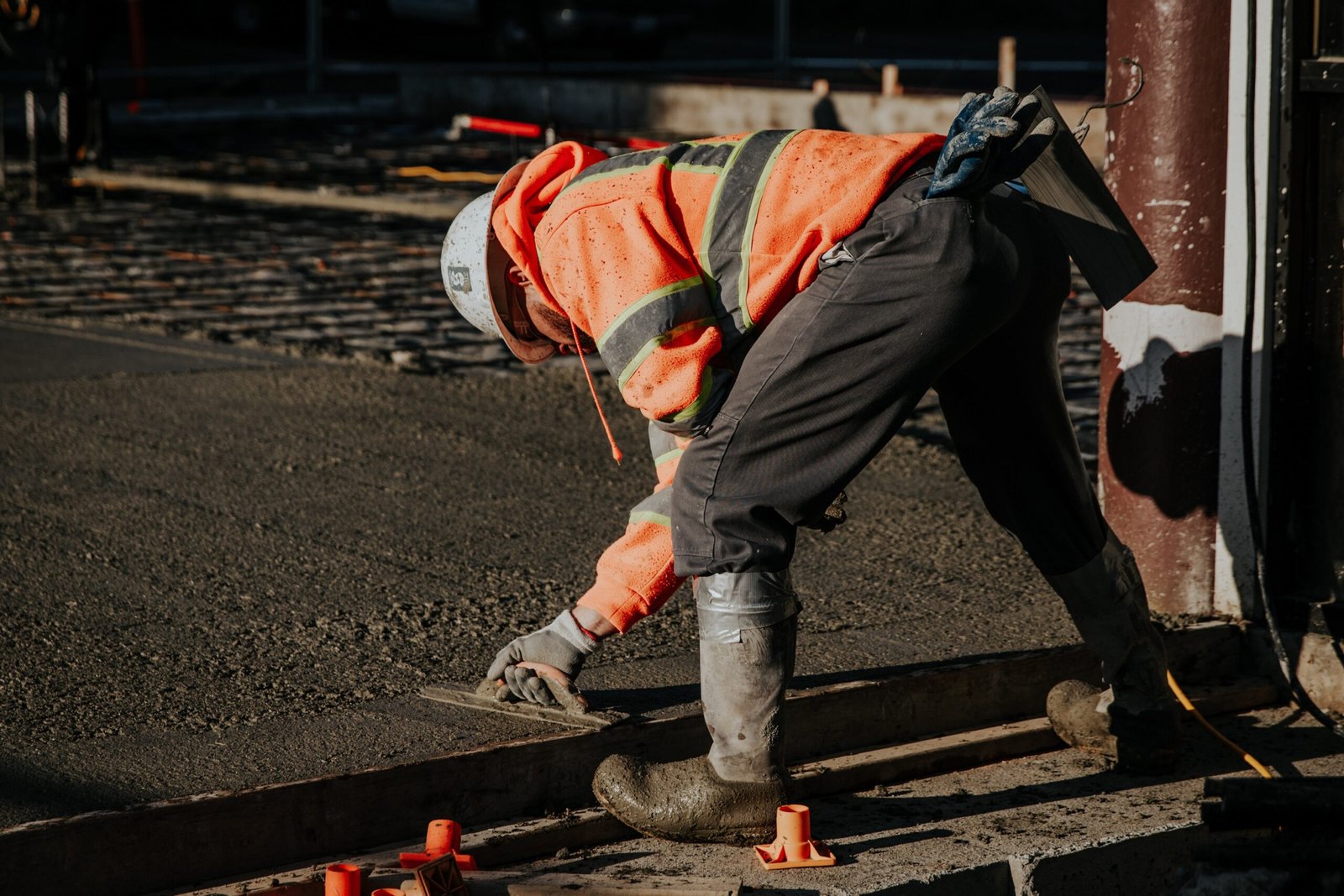
A smooth, dense finish achieved by manually or mechanically troweling the surface after concrete is poured and leveled.
- Tools: Hand trowel or power trowel
- Application Areas: Roof slabs, floors, internal concrete surfaces
- Features: Clean, fine finish; ideal for coatings and tiles
2
Broom Finish
After troweling, a broom is dragged across the surface to create rough texture.
- Purpose: Improves traction and slip resistance
- Ideal For: Parking lots, driveways, sidewalks
- Finish: Coarse texture; functional rather than decorative
3
Exposed Aggregate Finish
Top layer of cement paste is removed to expose decorative aggregates beneath.
- Method: Use surface retarders, then wash
- Materials: Colored stones, pebbles, shells, glass, etc.
- Application: Porches, decorative walkways, pool decks
- Benefits: Aesthetic appeal + anti-slip surface
4
Salt Finish
Rock salt is broadcast onto wet concrete and later washed away to leave a pitted surface.
- Texture: Fine, uniform depressions
- Use: Around swimming pools and wet areas
- Purpose: Slip resistance and surface texture
5
Stamped Concrete Finish
Stamped patterns are pressed into freshly placed concrete using textured mats or stamps.
- Design Options: Brick, stone, tile, wood patterns
- Add-on: Color pigments can be added for visual appeal
- Application: Driveways, patios, theme parks
- Purpose: Decorative, cost-effective alternative to natural materials
6
Stained/Colored Concrete Finish
Color is introduced to concrete through surface staining or pigment admixtures.
- Types: Acid staining, integral coloring, dry-shake hardeners
- Finish: Vibrant or subtle color tones
- Protection: Sealer applied to preserve color
- Usage: Lobbies, interiors, showrooms, patios
Summary Table
| Finish Type | Surface Texture | Application Areas | Key Benefits |
|---|---|---|---|
| Trowelled | Smooth, dense | Roof slabs, floors | Clean finish, base for tiles |
| Broom | Rough, ridged | Driveways, ramps | Slip resistance |
| Exposed Aggregate | Pebbled, decorative | Walkways, porches | Aesthetic + anti-slip |
| Salt | Pitted, fine | Pool surrounds | Water-resistant, non-slip |
| Stamped | Patterned, textured | Patios, themed spaces | Decorative appeal |
| Colored/Stained | Colored surface | Interiors, showrooms | Vibrancy, design versatility |
| Polished | Glossy, smooth | Malls, industrial floors | Durable, low maintenance |
| Swirl | Arched, textured | Outdoor slabs, public spaces | Visual enhancement, anti-skid |

- Concrete Curing
What is Curing of Concrete?
Curing is the process of maintaining moisture and temperature conditions in freshly placed concrete to ensure proper hydration of cement. Effective curing directly influences the strength, durability, and crack resistance of the final concrete structure.
Where Vision Meets Construction
- Fail to achieve its full compressive strength
- Suffer from surface cracks
- Lose long-term durability
💧 Ensure complete hydration of cement
💪 Achieve maximum strength and durability
🛡️ Prevent surface cracking due to moisture loss
🌡️ Regulate temperature and moisture under different climate conditions
Methods of Concrete Curing
Below are the most widely used concrete curing methods:
Shading (Covering from Heat & Wind)
- Covers the surface to reduce evaporation and protect from direct sunlight, wind, and rain.
- Particularly useful in hot or windy climates.
- Helps retain internal moisture and hydration heat in cold environments.
Best for: Walls, slabs in hot regions, cold climates.
Covering with Wet Materials
- The surface is covered with wet gunny bags, hessian cloth, or waterproof sheets.
- Helps retain surface moisture over time.
Best for: Pavements, slabs, beams, and columns.
Sprinkling Water
- Water is sprayed at intervals using nozzles or hose pipes.
- Maintains a damp surface, but requires regular attention to be effective.
May not ensure consistent moisture if not done frequently.
Ponding
- Common for horizontal surfaces like slabs and pavements.
- A boundary is made using clay or sand around the surface, and water is pooled over it.
- Ensures uniform moisture and cooling.
Best for: Floors, pavements, and terrace slabs.
Membrane Curing
- A curing compound or waterproof membrane (e.g., bitumen emulsion, wax, rubber latex) is applied over the concrete.
- Forms a seal that traps moisture within the surface.
Suitable for: Large concrete areas and remote sites with limited water access.
28 days of membrane curing is equivalent to 14 days of moist curing.
Steam Curing
- Used mostly for precast concrete elements.
- Involves exposing concrete to moist heat or steam at controlled temperatures.
- Speeds up the hydration process and reduces curing time.
Ideal for: Factory-cast slabs, blocks, poles, and precast elements.
Summary Table
| Method | Application Area | Key Benefit |
|---|---|---|
| Shading | Outdoor slabs, columns | Reduces evaporation, keeps surface moist |
| Wet Covering | Pavements, beams, slabs | Maintains consistent surface moisture |
| Sprinkling Water | Small-scale works | Easy but needs frequent monitoring |
| Ponding | Floors, flat surfaces | Ensures full moisture retention |
| Membrane Curing | Large areas, remote sites | Water-saving, effective seal |
| Steam Curing | Precast factory elements | Rapid strength gain, faster curing |